Using mindminder as an Organisation
mindminder was designed from lived experience trying to co-support aged relatives across a number of siblings who lived remotely. Add into the mix the introduction of domiciliary carer visits and it's easy to imaging four or more Carers wishing to support an individual and monitor their condition.
This is where the concept of mindminder's "Organisations" becomes relevant.
An Organisation is a conceptual group within mindminder which allows a relationship to be set up between a Carer (or Carers) and User (or Users).
In simple terms, Users and Carers cannot interact without first being members of the same Organisation. Equally, Carers and Users not sharing an Organisation cannot interact at all.
An Organisation can be viewed as a specific room both Carers and Users can mutually access to interact.
The Organisation concept may seem to add complication to a Carer/User relationship however it’s the key way in which secure interaction can be assured; both in allowing Carers to securely co-ordinate User-specific content and also to securely access only the data provided by Users in their own Organisation.
The Organisation concept is not constrained by mindminder; an Organisation could be:
A family unit; Carer(s) and User(s) are part of a family
A medically-aligned organisation such as a GP Surgery, Clinic, etc.
A carer organisation such as a Domiciliary Care provider
A group of care or therapy clients with a therapist
A community group or club,
A physical location such as a ward within a building, or even a Village, street etc.
Once a Carer is a member of an Organisation, Users in that organisation become candidates for being supported by the Carer. HOWEVER mindminder’s security arrangements ensure that ONLY once member of a shared Organisation AND a User’s specific account details are provided, can a Carer and User interact. Organisational groupings allow aggregate data and statistics to be acquired for the User population without all members of the Organisation having access.
Organisation Examples
It’s important to consider that a User, and Carer, can be members of a number of Organisations all at once. A Carer may work for a care provider company but also intermittently work for another care provider or residential home and also support their own relative through a family organisation.
A User may be a member of a care provider organisation but also a GP's surgery and family organisation concurrently.
Not every GP in the GP Surgery Organisation has the User’s details and so only a User's own GP can interact with their User data.
Carers cannot tell which Organisations a User is a member of to preserve the privacy of Users.
Domiciliary Care/Care Home
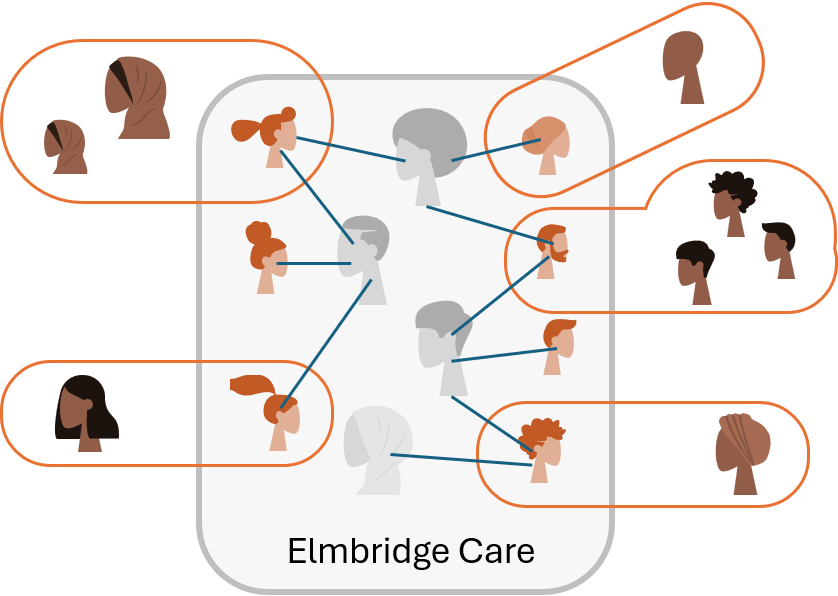
As an example, consider a Domiciliary Care Company, or Residential Care Home, called “Elmbridge Care”. A lead person for Elmbridge Carer create a company-wide Organisation and Users are added to the Organisation.
Carers within the company then join "Elmbridge Care" with their Carer accounts.
“Elmbridge Care” Carers in the Organisation may only provide care to specific clients and so, even though all of the organisation's Carers are added as members of the "Elmbridge Care" Organisation, only the details of Users each Carer supports are provided such that only their own clients can be accessed. However at Organisation level, aggregate User statistics are available such that, for example, a new meal programme is launched and the overall impact on the Elmbridge Care clients’ wellbeing can be seen over time in the collective data they provide.
Family Example
Consider a family with Jo and Robin wishing to provide support to their father, Arthur.
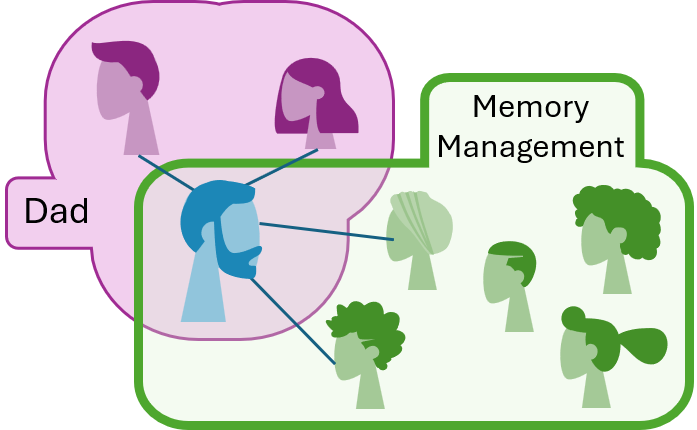
They each create Carer accounts and a User account for Arthur, and Jo then creates a “Dad” family Organisation which they all link with via their Carer/User accounts. As they are all in the same Organisation, Jo and Robin can support Arthur.
Over time, Arthur may discuss his challenges with his memory with a visiting care worker who then obtains Arthur’s User account details (provided via Robin), adds Arthur to the local surgery “Memory Management” team Organisation and the care worker and another nurse link with Arthur’s User account. Note that despite membership of the Memory Management Organisation, the three other nurses at the surgery cannot interact with Arthur at this stage due to mindminder’s security settings; they need to be a member of the same Organisation AND know Arthur's details before such a link can be made.